 ChronoWaves
Symbolic and Esoteric Traditions
Biorhythm waves, meaningful numbers, celestial maps, harmonious spaces, illustrated cards, hands, dreams, hexagrams, runes and pendulums all turn something unseen into a pattern people can contemplate.
What brings these traditions together?
They are all symbolic and esoteric traditions: systems through which people have explored timing, character, fortune, place or possibility.
They do not all come from the same culture, era or purpose. Feng shui is a living Chinese tradition concerned with place and orientation; tarot began as a card game; astrology grew from observing the sky; numerology gives qualities to numbers; palmistry reads the hand; dream interpretation explores remembered sleep; the I Ching arranges broken and unbroken lines; runes began as letters; dowsing uses responsive tools; and classic biorhythms draw repeating curves from a birth date.
This guide explores cultural history and reflective meaning. It does not treat symbolic interpretation as a substitute for scientific, medical, financial or other professional advice.
Classic biorhythms
Three smooth curves give shape to physical, emotional and intellectual themes across repeating 23, 28 and 33-day cycles.
The model emerged around the turn of the twentieth century from periodic theories associated with Wilhelm Fliess and Hermann Swoboda. It found a new audience in the 1970s, when printed charts, arcade machines and pocket calculators made a once-laborious calculation feel immediate and personal.
When the curves reached the cockpit
Aviation organisations once explored whether critical biorhythm days might help predict accidents. A 1981 NASA technical memorandum reviewed birth-date biorhythm claims alongside genuine circadian science and treated the proposed accident prediction method critically. The episode is a vivid reminder that two ideas can both use the language of rhythm while resting on very different evidence.
Reflective model, not a validated predictor
Numerology
Numerology treats numbers as qualities and relationships, not only quantities.
Modern readings often reduce a name or birth date to a smaller number and associate it with a theme. The broader fascination is much older: Pythagorean traditions gave special prominence to numerical relationships and imagined the cosmos as an ordered harmony.
The music hidden inside number
A famous story says Pythagoras heard blacksmiths’ hammers and discovered musical harmony in their weights. The account was written centuries after his lifetime and the proposed experiment does not survive a physics check, yet the deeper relationship is real: musical intervals such as the octave and fifth correspond to simple whole-number ratios. The legend endured because it captures an irresistible idea – that number might let us hear order in the world.
Number as proportion, pattern and symbol
Astrology and horoscopes
Astrology reads the positions of celestial bodies as a symbolic map of character, timing and earthly affairs.
A horoscope is a chart for a particular moment and place. Its circular form divides the sky into signs and houses, then records relationships between the Sun, Moon and planets. Astronomy and astrology once shared close observational roots, but modern science does not support astrological prediction.
A horoscope pressed into clay
The British Museum holds a small cuneiform* tablet from ancient Babylon identified as a horoscope. Long before a birth chart could appear instantly on a screen, a trained scribe had to calculate and inscribe a celestial moment by hand. The tablet makes astrology’s long history unexpectedly tangible: an individual sky preserved in baked clay.
* Cuneiform is an ancient system of wedge-shaped writing pressed into clay, used across Mesopotamia and neighbouring regions.
at one moment
A symbolic chart, distinct from astronomical measurement
Feng shui
Literally “wind and water”, feng shui is a Chinese tradition concerned with how people, buildings, landforms, directions and flows relate.
It is much broader than a list of decorating tips. Different schools use observation of landscape, compass directions, yin and yang, the five phases and the bagua. A traditional luopan compass surrounds a magnetic needle with rings of information used to read orientation and correspondence.
Emperors between Earth and Heaven
Studies of China’s imperial necropolises show that tomb complexes were not conceived as isolated buildings. Mountains, waterways, celestial cycles and changing feng shui traditions helped shape entire sacred landscapes. The story makes the central idea easier to grasp: placement can connect a human structure to a much larger order.
yang
A living cultural tradition with multiple schools
Tarot cards
A tarot reading arranges illustrated cards so that their symbols, positions and relationships can prompt a story or reflection.
A standard modern deck contains 78 cards: 22 Major Arcana and 56 Minor Arcana. Readers differ widely in method. Some use the cards for fortune-telling; others use them as creative prompts or a structured way to consider a question from unfamiliar angles.
Before divination*, there was a game
The earliest tarot references cluster around fifteenth-century northern Italy. Luxury decks such as the gold-ground Visconti-Sforza cards were made for elite courts and used for trick-taking games. According to The Metropolitan Museum of Art, tarot’s now-familiar association with fortune-telling and occultism gained currency only in the nineteenth century.
* Divination means trying to discover the future, hidden knowledge or guidance by interpreting signs, symbols or rituals.
The meaning emerges from image, position and question
Palmistry
Palmistry, also called chiromancy, interprets the hand’s lines, fingers, mounts and overall form as signs of character or possibility.
Palm-reading traditions developed in different cultures, including India, China and Europe, so there is no single universal map. In modern anatomy, the major lines are palmar flexion creases that help the skin fold as the hand moves; their use as predictors is not scientifically validated.
A seventeenth-century guide to the palm
Wellcome Collection preserves an illustrated English manual of practical chiromancy dated 1648. Its three carefully labelled hands show how readers tried to turn the living hand into a portable system of signs. A later Indian diagram lettered in Sanskrit is a useful reminder that palmistry has several cultural histories, not one continuous European lineage.
Traditional labels describe an interpretive system, not anatomical destiny
Dream interpretation
Dream interpretation turns remembered images, emotions and events into possible messages about the dreamer, the future or the inner life.
Ancient omen manuals, religious traditions, psychoanalysis and modern reflective practice ask very different questions of dreams. Sleep science can study when dreaming occurs and how it relates to memory and emotion, but it has not established a universal dictionary in which each dream symbol has one fixed meaning.
A dream book with another life on its back
The British Museum’s Papyrus Chester Beatty III, made around 1220 BCE and associated with the scribe Qenherkhepshef of Deir el-Medina, sorts dreams into good and bad omens. The reverse was reused for a poem and part of a letter. One object therefore preserves both a formal guide to mysterious night visions and traces of ordinary literary life.
Context changes the reading; no symbol has one proven universal meaning
I Ching
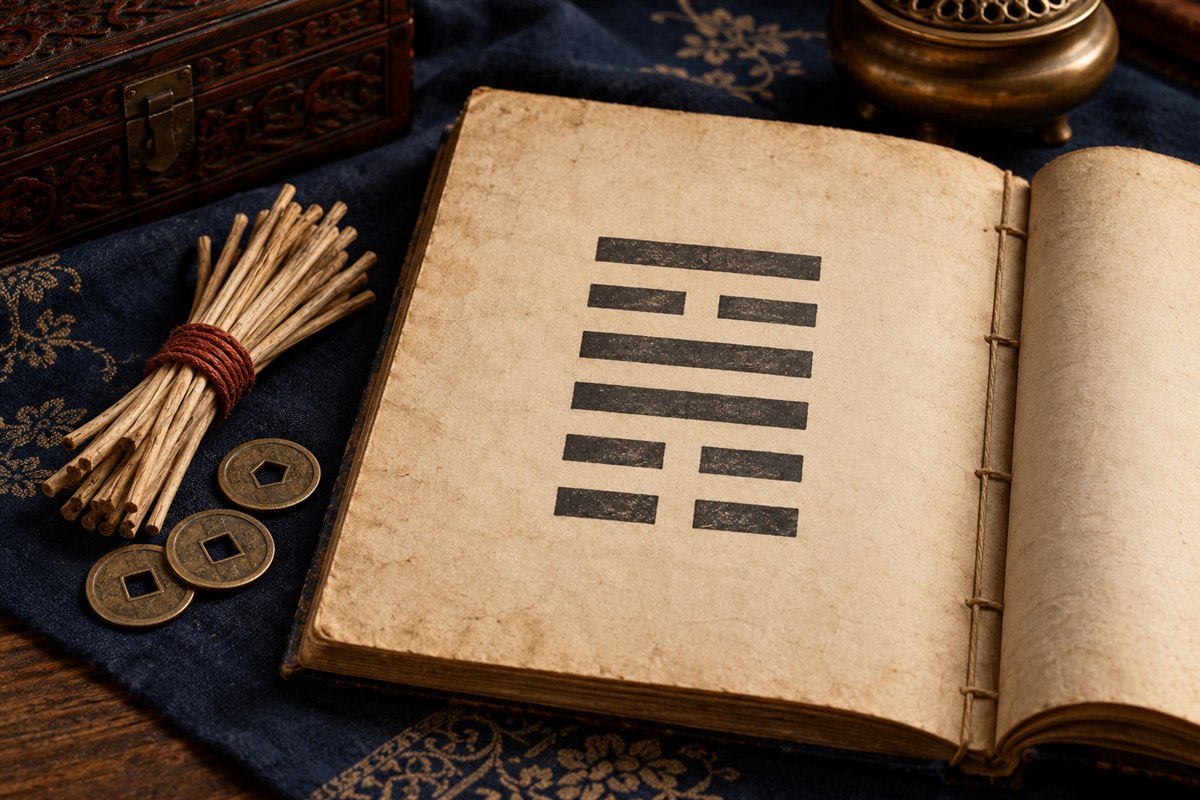
Chinese hexagrams formed from broken and unbroken lines have a remarkable history stretching back thousands of years.
The Yijing, or Book of Changes, is a layered Chinese classic whose early core took shape in the Zhou period and grew through centuries of commentary. Its 64 hexagrams each contain six lines. A line may be unbroken or broken, and the resulting figure is read together with an associated text.
From divination manual to philosophical classic
The oldest layers offered judgments for particular situations. Later writers used the same figures to explore change, ethics, government, nature and the relationship between human life and the wider cosmos. Methods using yarrow stalks or coins select a hexagram for consultation, but the book’s influence reaches far beyond divination.
Runes
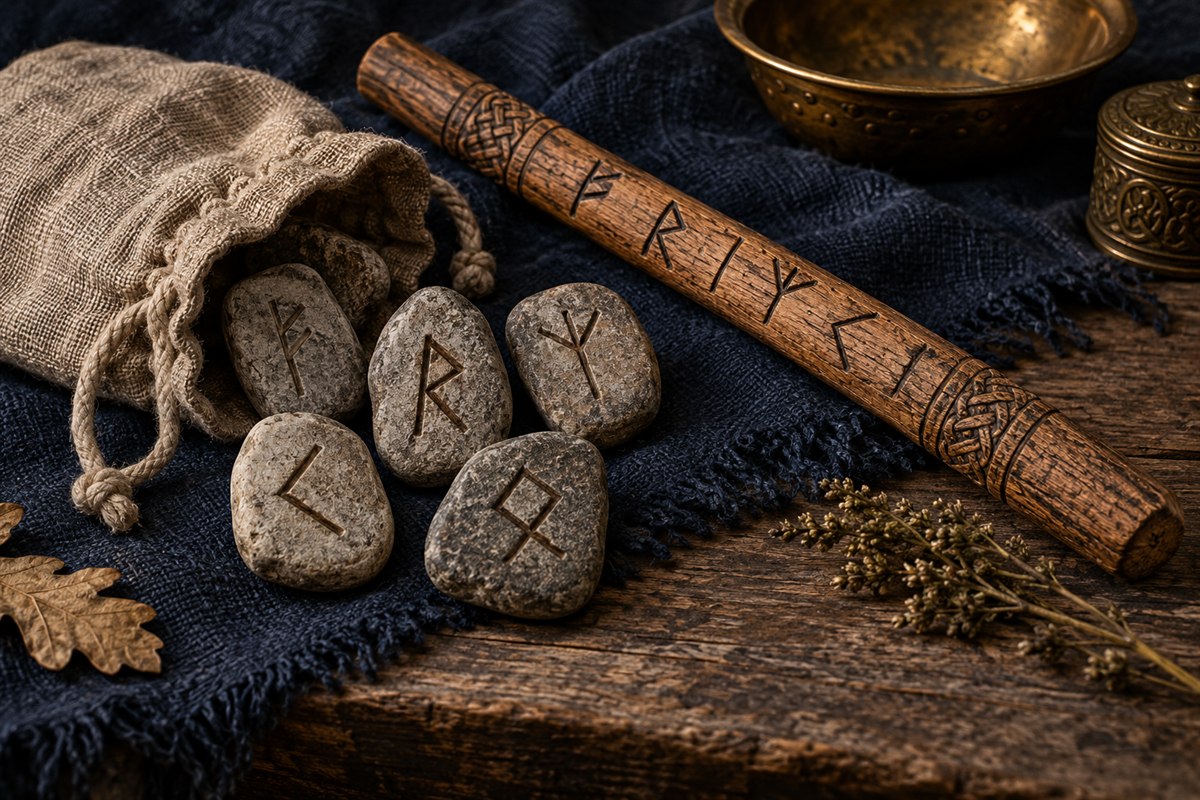
Runes were originally Germanic letters and were later adopted in various symbolic, magical and divinatory readings.
Runic alphabets are called futharks after their opening characters. They changed across time and place, and were carved into wood, bone, metal and stone for names, memorials, ownership marks, messages and everyday communication. Most surviving inscriptions are more practical than mysterious.
Writing first, divination later
Old Norse literature and some inscriptions connect runes with charms, protection and curses, yet modern rune casting should not be treated as an unchanged Viking practice. The National Museum of Denmark notes that much of the familiar idea of runic magic was shaped in medieval, early-modern and modern traditions.
Dowsing and pendulums
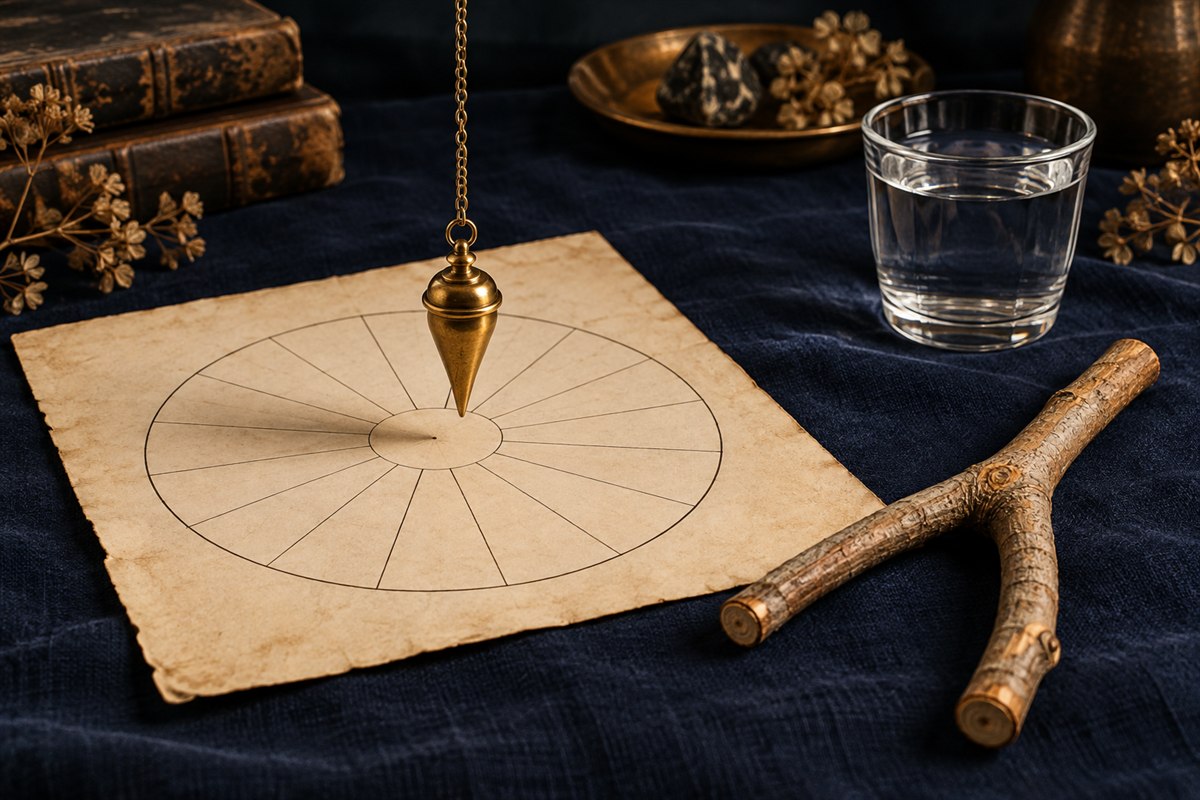
Dowsing rods and pendulums have traditionally been used to seek water or objects, and to offer yes-or-no guidance.
Practices vary: a forked branch or paired rods may be carried across land, while a suspended pendulum is watched for a change of direction. Small unconscious muscular movements can create convincing motion—an effect known as the ideomotor response. Controlled evidence does not support dowsing as a reliable way to locate groundwater.
When “water witching” reached the USGS
By 1917, the United States Geological Survey had received so many enquiries that it published a historical review of the divining rod. Its conclusion was blunt: geology, hydrology and direct investigation are dependable ways to assess groundwater; the apparent success of a rod is not evidence that it detects hidden water.
What does each tradition turn into a pattern?
They share an appetite for correspondence, but their raw materials and cultural histories are distinct.
Patterns can be mirrors without being measurements
Part of the appeal lies in the pause each system creates. A curve, number, chart, room, card spread, hand, dream, hexagram, rune or moving pendulum can make an abstract concern visible enough to talk about. That can inspire observation without proving that the system predicts what will happen next.
Chronobiology belongs to a different category: it tests biological rhythms using observations, experiments and measurable signals. Holding that distinction clearly lets cultural curiosity and scientific literacy coexist.
Compare classic biorhythms with biological rhythmsFrequently asked questions
Not all ten traditions are forms of it. Astrology, tarot, palmistry, the I Ching, later rune reading, dowsing and some forms of numerology or dream interpretation can be used for divination, but each has a distinct history. Feng shui is a broader Chinese tradition of place and orientation, runes began as writing, and classic biorhythms are a modern mathematical cycle model. “Symbolic and esoteric traditions” is the more inclusive umbrella.